Solving Kinematic Problems in Special Relativity via Quantitative Spacetime Diagrams
利用定量时空图解决狭义相对论运动学问题
Contents
我是个很笨的人。
小学的时候总是想不清鸡兔同笼。
看着同桌迅速地加加减减,
号令兔子抬脚落脚,
轻松就变出了答案。
我很羡慕。
直到有一天,
我听说了二元一次方程组……
I am not very bright.
In primary school, I could never get my head around chickens-and-rabbits word problems.
I watched the classmate sitting next to me adding and subtracting at lightning speed,
ordering the rabbits to lift their feet and put them down,
and conjuring up the answer with no effort at all.
I was so envious.
Until one day,
I heard about systems of linear equations in two variables…
本文旨在借助时空图这一工具帮助读者避免思考时的混乱,
This article uses spacetime diagrams to help keep your thoughts from getting tangled up,
让狭义相对论运动学问题变得易如反掌。
and make kinematics problems in special relativity a piece of cake.
首先我们需要引入一些预备知识。
First, we need a little background.
一、事件、世界线与时空图
I. Events, Worldlines, and Spacetime Diagrams
某一个事件的发生,可以用它的空间和时间坐标表示。
An event can be specified by the spatial and temporal coordinates at which it happens.
比如某质点在时刻 \(t \) 哭了,此时他的空间位置是 \((x,y,z)\) ,那么“哭了”这一事件就可以用上述空间、时间坐标来表示,若将此事件记为 \(A\) ,则可以表示为 \(A(ct,x,y,z)\) 。这里附加的常数因子 \(c\) 在保持量纲一致的基础上,可以与洛伦兹变换相协调。
For example, suppose a particle bursts into tears at time \(t \), at the spatial position \((x,y,z)\). Then the event “burst into tears” can be represented by those space and time coordinates. If we call the event \(A\), we can write \(A(ct,x,y,z)\). The extra constant factor \(c\) keeps the dimensions consistent and fits neatly with the Lorentz transformation.
倘若有一质点在空间中运动,满足 \(\vec{r}=\vec{r}(t)\) ,则该方程代表了 \((ct,x,y,z)\) 空间中的一条曲线,称为该质点的世界线。简化到质点仅作一维运动的情况,即仅有 \((ct,x)\) 时,则可将这一条曲线绘制于平面上。我们把这样的图像称为时空图。
If a particle moves through space according to \(\vec{r}=\vec{r}(t)\), this equation describes a curve in \((ct,x,y,z)\) space, called the particle’s worldline. Simplify to one-dimensional motion, where we only have \((ct,x)\), and we can draw the curve on a plane. We call this a spacetime diagram.
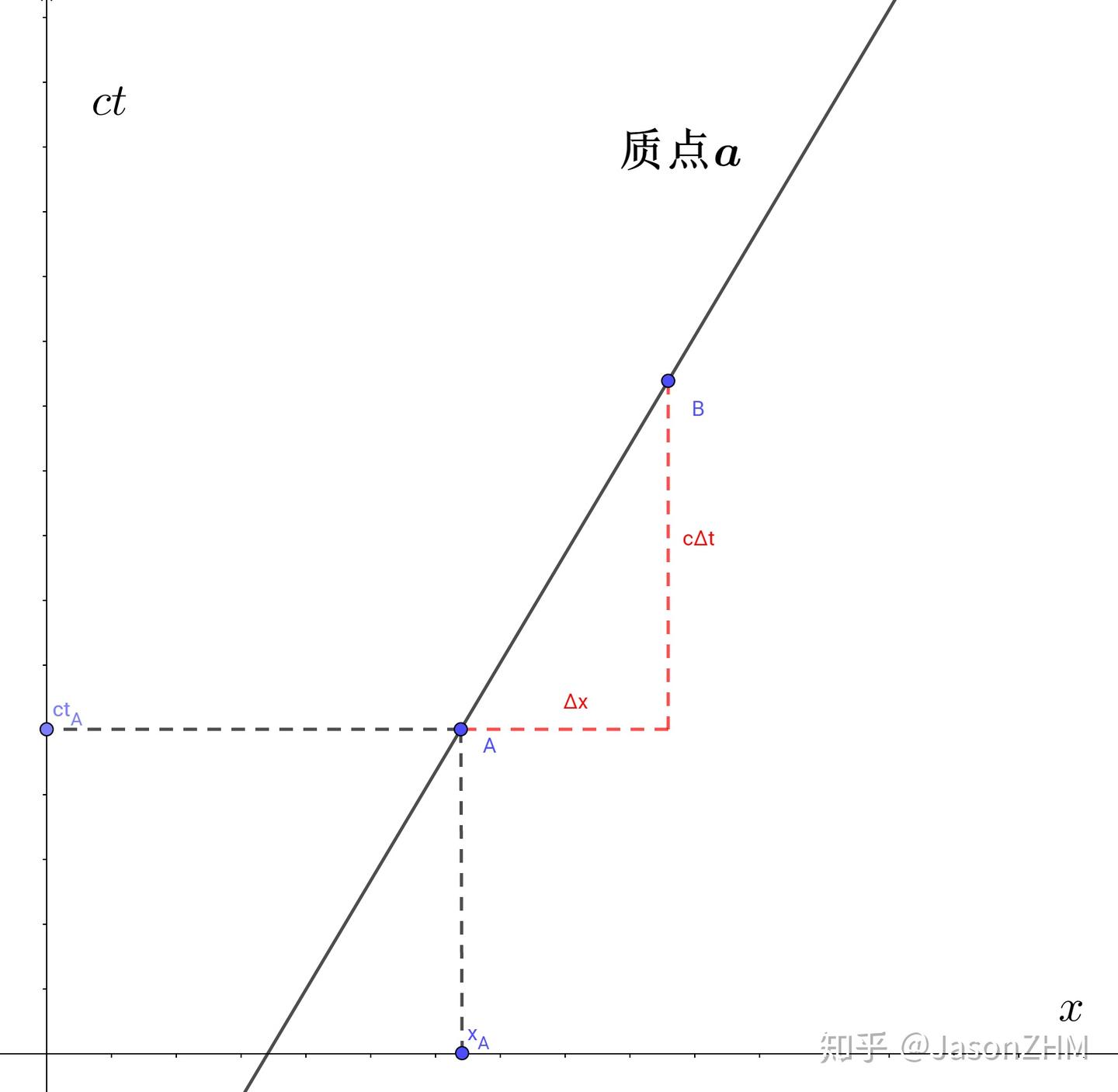
上图表示的就是一个匀速直线运动的质点a在时空图中的世界线,在经历事件\(A(ct_A, x_A)\) \(\Delta t\) 时间后移动距离 \(\Delta x\) 并经历事件 \(B\) 。
The figure shows the worldline of a particle a moving at constant velocity in a straight line. After event \(A(ct_A, x_A)\), it moves a distance \(\Delta x\) over a time \(\Delta t\) and reaches event \(B\).
这个图大家在小学数学中应该就很熟悉了,无非就是把s-t图的坐标轴倒了一倒。
You should recognize this from primary-school maths. It is just a distance–time graph with the axes swapped.
以 \(\beta=v/c\) 为速度运动的粒子的世界线显然就是一条斜率为 \(1/\beta\) 的直线。
The worldline of a particle moving with velocity \(\beta=v/c\) is clearly a straight line of slope \(1/\beta\).
而所谓光信号的世界线就是一条45°的直线。
The worldline of a light signal is a straight line at 45°.
二、洛伦兹变换与时空间隔
II. Lorentz Transformations and Spacetime Intervals
那么这个时空图与狭义相对论有什么样的关系呢?
So what does this spacetime diagram have to do with special relativity?
我们来观察一下洛伦兹变换(式中 \(\beta=v/c, \gamma=\frac{1}{\sqrt{1-\beta^2}}\) ,且两参照系于 \((0,0)\) 点对齐): \(ct'=\gamma(ct-\beta x),\\ x'=\gamma(x-\beta ct).\)
Let us look at the Lorentz transformation, where \(\beta=v/c, \gamma=\frac{1}{\sqrt{1-\beta^2}}\) and the two reference frames coincide at \((0,0)\): \(ct'=\gamma(ct-\beta x),\\ x'=\gamma(x-\beta ct).\)
接下来我们回忆平时学的几何当中距离的定义,你会发现距离最重要的特征就是不随观察方式的变化而变化。
Now think back to how distance is defined in ordinary geometry. Its most important property is that it does not change with how you look at things.
换句话说,空间中两个点的距离,我坐着看、躺着看,都应该是一样的。
In other words, the distance between two points should be the same whether I look at them sitting up or lying down.
但是在狭义相对论中普通的空间距离不再具有这种性质了,因为 \(\Delta x'=\gamma(\Delta x-\beta \Delta ct)\) 。
But ordinary spatial distance no longer has this property in special relativity, because \(\Delta x'=\gamma(\Delta x-\beta \Delta ct)\).
所以如果我们能够构造出一个新的量 \(\text{d}s\) ,能够不随观察方式而改变,就能够大大方便我们的处理,同时我们时空图中两个事件之间的距离也就可以有定义了。
So if we can construct a new quantity \(\text{d}s\) that does not change with the way we observe things, it will make life much easier. It will also give us a definition of the distance between two events in a spacetime diagram.
为了达到这一目标,我们试着将洛伦兹变换的两个式子微分之后平方相减,就可以得到
To do this, let us differentiate the two Lorentz-transformation equations, square them, and subtract. We get
\(\text{d}ct'^2-\text{d}x'^2=\text{d}ct^2-\text{d}x^2,\) 这一关系表明 \(\text{d}s^2=\text{d}ct^2-\text{d}x^2\) 这个物理量是不随观测者的改变而改变的,因而我们将这样定义出来的 \(\text{d}s\) 称作时空间隔。
\(\text{d}ct'^2-\text{d}x'^2=\text{d}ct^2-\text{d}x^2,\). This tells us that the physical quantity \(\text{d}s^2=\text{d}ct^2-\text{d}x^2\) does not change from one observer to another. We call \(\text{d}s\), defined this way, the spacetime interval.
接着我们就可以把这样定义出的距离用作时空图中距离的定义,可见时空图中不再遵循欧几里得的勾股定理,取而代之的是被称为闵氏几何中的“勾股定理” \(c^2=a^2-b^2\) 。
We can now use this as the definition of distance in our spacetime diagram. The diagram no longer obeys the Euclidean Pythagorean theorem. Instead, it obeys the “Pythagorean theorem” of Minkowski geometry: \(c^2=a^2-b^2\).
此处还有一点细节上的问题,即如果 \(\text{d}s^2=\text{d}ct^2-\text{d}x^2<0\) 怎么办?
There is one small detail: what if \(\text{d}s^2=\text{d}ct^2-\text{d}x^2<0\)?
这时我们约定取其绝对值再开方,即 \(\text{d}s=\sqrt{|\text{d}ct^2-\text{d}x^2|}\) 。
In that case, we agree to take the absolute value before taking the square root: \(\text{d}s=\sqrt{|\text{d}ct^2-\text{d}x^2|}\).
并且我们将 \(\text{d}s^2>0\) 的情况称为类时的(更靠近时间轴),
We call the case \(\text{d}s^2>0\) timelike, since it lies closer to the time axis;
\(\text{d}s^2<0\) 的情况称作类空的(更靠近空间轴),
the case \(\text{d}s^2<0\) spacelike, since it lies closer to the space axis;
而 \(\text{d}s^2=0\) 的情况称为类光的(只有光能这么玩儿)。
and the case \(\text{d}s^2=0\) lightlike—only light gets to play this game.
可见一般实物粒子的世界线都是类时的。
So the worldlines of massive particles are timelike.
三、建立一些直觉
III. Building Some Intuition
讲了这么半天花里胡哨的定义,我们现在来建立一些更practical的直觉,帮助我们感性地理解时空图到底是怎么用的。
Enough of these fancy definitions. Let us build some more practical intuition for how to actually use a spacetime diagram.
我们先来看一下换参照系后坐标轴的变化。
First, what happens to the coordinate axes when we change reference frames?
所谓坐标轴就是满足 \(x'=0\) 和 \(ct'=0\) 的曲线,前者称为撇系的时间轴,后者为空间轴。
The coordinate axes are simply the curves satisfying \(x'=0\) and \(ct'=0\). The first is the time axis of the primed frame, and the second its space axis.
而坐标轴只是更一般的“撇系的等时线” \(ct'=\text{const.}\) 和“撇系的等位置线”(这是我自己编的名字) \(x'=\text{const.}\) 的特例。
The axes are just special cases of the more general equal-time lines of the primed frame, \(ct'=\text{const.}\), and its equal-position lines—a name I made up—\(x'=\text{const.}\).
我们把这些塞进洛伦兹变换,就可以得到“等时线”(对应 \(x'\) 轴)是直线 \(ct=\beta x+\text{const.}\) ,斜率为 \(\beta<1\) ,即一组靠近 \(x\) 轴的平行直线。
Plug these into the Lorentz transformation. The equal-time lines, corresponding to the \(x'\) axis, are the straight lines \(ct=\beta x+\text{const.}\), with slope \(\beta<1\): a family of parallel lines lying close to the \(x\) axis.
同理“等位置线”(对应 \(ct'\) 轴),是直线 \(x=\frac{1}{\beta}ct+\text{const}.\) ,一组靠近 \(ct\) 轴,且倾斜程度与等时线关于45°线对称的平行直线。
Likewise, the equal-position lines, corresponding to the \(ct'\) axis, are the lines \(x=\frac{1}{\beta}ct+\text{const}.\). They form a family of parallel lines close to the \(ct\) axis, with the same tilt as the equal-time lines reflected across the 45° line.
在下图中可以看得比较清楚:
The following diagram makes this clearer:
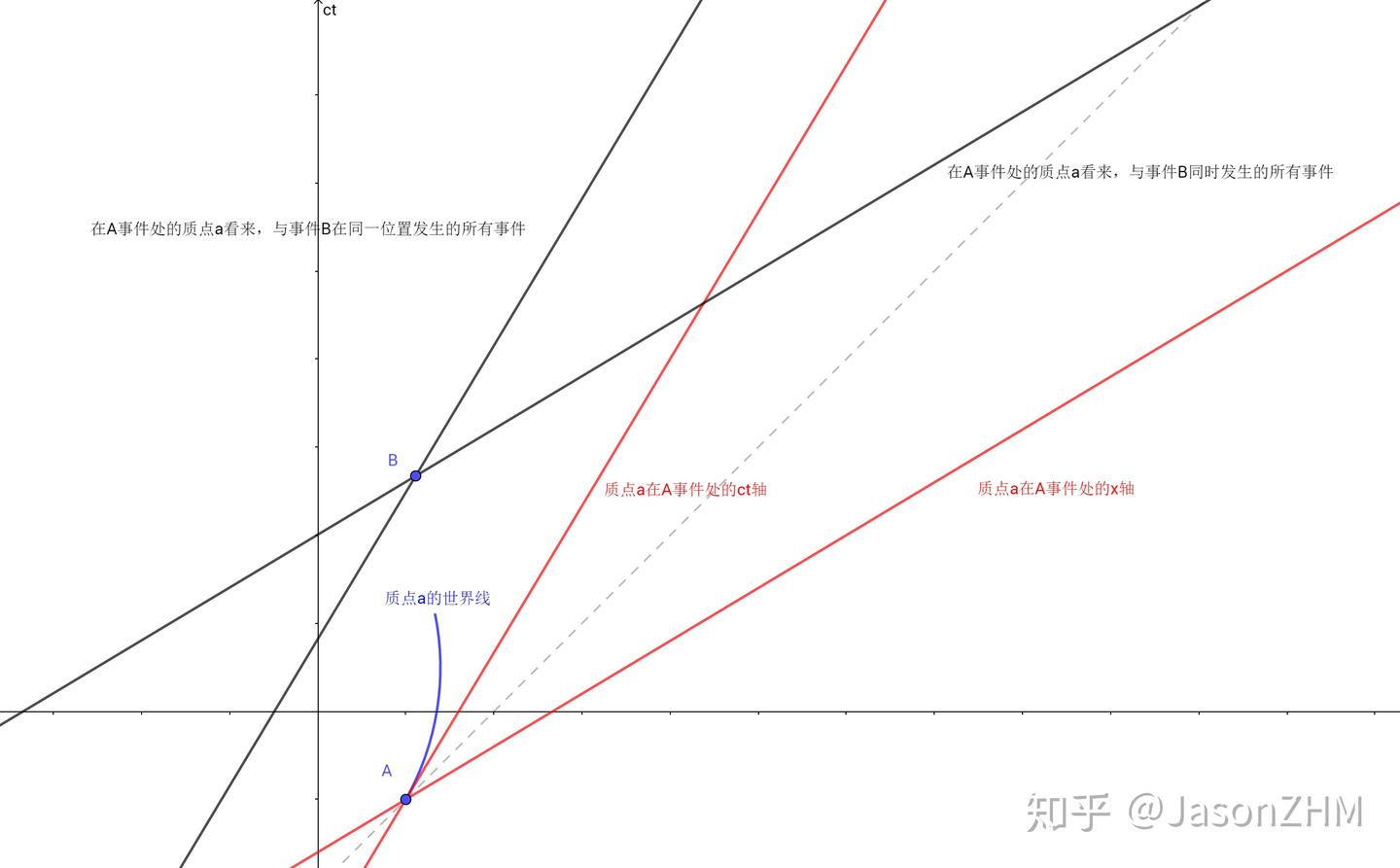
最重要的,这些线的物理意义是:在撇系看来,线上的所有时间都在同一时刻/位置发生。
Most importantly, their physical meaning is this: in the primed frame, all events on a given line occur at the same time or the same position.
这一点在判断及利用“同时”条件时非常有用。
This is extremely useful for identifying and using conditions of simultaneity.
接下来我们来看一下世界线长的意义。
Next, let us look at what the length of a worldline means.
世界线长由\(l_{AB}=\int_A^B\text{d}s=\int_A^B\sqrt{\text{d}ct^2-\text{d}x^2}\) 所定义。
Worldline length is defined by \(l_{AB}=\int_A^B\text{d}s=\int_A^B\sqrt{\text{d}ct^2-\text{d}x^2}\).
为了处理这个根号,我们想能不能把根号里的东西变成一项开出来。
To deal with that square root, can we reduce what is inside to a single term and take the root directly?
这时候我们就想到了所谓固有时 \(\tau\) ,即在质点本征系中改变的时间,根据其定义,本征系中自己是不动( \(\text{d}x'=0\) ),可得 \(\text{d}s^2=\text{d}c\tau^2-\text{d}x^2=\text{d}c\tau^2\) 。因此,\(l_{AB}=\int_A^B\text{d}\tau=\tau_{AB}\) 。
This brings us to proper time, \(\tau\): the time elapsed in the particle’s own rest frame. By definition, the particle does not move in that frame, \(\text{d}x'=0\), so \(\text{d}s^2=\text{d}c\tau^2-\text{d}x^2=\text{d}c\tau^2\). Therefore, \(l_{AB}=\int_A^B\text{d}\tau=\tau_{AB}\).
质点的世界线长等于其固有时间隔。这是一个非常重要的结论,可以方便地处理求解“经历时间”的问题。
The length of a particle’s worldline equals its proper-time interval. This is a very important result, and makes “elapsed time” problems easy to handle.
无论质点是否做匀速直线运动,这一结论都成立。换句话说,其实即使是有加速运动的问题,只要我们画时空图的这个参照系仍然是惯性系,即我们始终不换到非惯性系中去,都可以在狭义相对论的框架下处理。
This holds whether or not the particle moves in a straight line at constant velocity. In other words, even problems involving acceleration can be handled within special relativity, as long as the frame in which we draw the spacetime diagram is still inertial—as long as we never switch into a noninertial frame.
比如说双生子佯谬的问题。相当于比较折线和直线的长度,而在闵氏几何下,显然后者更长。
Take the twin paradox, for example. It amounts to comparing the length of a broken line with a straight one. In Minkowski geometry, the latter is clearly longer.
许多题目中的对钟也就可以理解为把固有时(线长)的计算零点设为给定点。
Setting clocks in many problems can then be understood as choosing a given point as the zero from which proper time, or worldline length, is measured.
最后引入一点实际计算上定量的直觉,方便解题。
Finally, a little quantitative intuition to make the actual calculations easier.
时空图遵从闵氏几何,三角形的斜边的平方等于两直角边平方之差。
A spacetime diagram follows Minkowski geometry: the square of a triangle’s hypotenuse is the difference between the squares of its two legs.
在运动学问题中,我们经常会处理一类直角边分别为 \(1\) 和 \(\beta\) 的三角形,根据“勾股定理”其斜边长则为 \(\sqrt{1-\beta^2}\) ,如下图所示:
In kinematics problems, we often encounter right triangles with legs \(1\) and \(\beta\). By the “Pythagorean theorem,” the hypotenuse is \(\sqrt{1-\beta^2}\), as shown below:
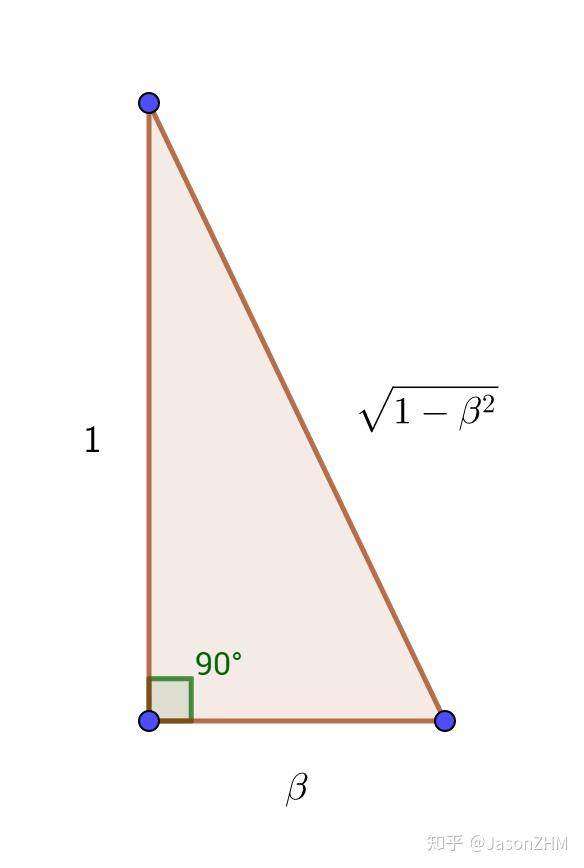
值得注意的是,该三角形无论是竖着还是倒着都满足这样的比例关系。利用这一结论可以大大加快解题的速度。
Note that these proportions hold whether the triangle stands upright or is turned on its side. This can make solving problems much faster.
其余的相似三角形、平行线的比例关系以及一般的解析几何知识在时空图中都是可以直接应用的。解题的时候可以设出某些未知边的长度,通过几何关系建立等量关系求解。
The usual ratios for similar triangles and parallel lines, and ordinary analytic geometry, can all be used directly in a spacetime diagram. When solving a problem, assign variables to some unknown side lengths, write down equalities from the geometry, and solve.
四、结语
IV. Closing Thoughts
至此,我们已经将狭义相对论运动学问题转化为简单的平面几何问题。
We have now turned kinematics problems in special relativity into simple plane-geometry problems.
读者可以找一些常见竞赛参考书上的题目小试牛刀。
Try it out on some problems from the standard physics Olympiad preparation books.
最后说一点题外话。
A little aside before I finish.
在本文写作的时候,我已经退役了一个月了。竞赛的最终结果比我能想象到的最差成绩还要差。硬要分析,某种意义上算是去年失利覆辙的重蹈,主要在于解题顺序上的失误。可惜解释再多也没有意义。纵使深恩负尽,满盘遗憾,生活还是要继续。
As I write this, it has been a month since my physics Olympiad run came to an end. The final result was worse than the worst result I had imagined. If I had to analyze it, in a way I repeated last year's failure, mainly by choosing the wrong order in which to tackle the problems. But no amount of explanation makes any difference now. Even if I have let down everyone who has done so much for me and am left with nothing but regret, life has to go on.
退役后的高三生活比我想象中的友好很多。虽然2020年自主招生的形势极不明朗,而所谓的最优惠条件多半终是杯水车薪。或许是因为,在进入省队之前,我其实从未真正地把自己当做一名竞赛生。我学业上的追求有很多,综合、竞赛、科研。可是刨除繁华的外衣,我自始至终是一名依靠综合成绩走过来的学生,是一名所谓的综合党。只不过课业之外,心有余力,才会去接触竞赛等等。所以最后的结果大概是某种意义上的均值回归。或许这就是我比一些其他同样痛失竞赛的同学们适应得稍微好一些的原因吧。
Life in my senior year of high school after my Olympiad run ended has been much kinder than I expected. This is despite all the uncertainty over universities' special admissions programs for 2020, and the likelihood that even the biggest admissions advantage would still be a drop in the bucket. Perhaps it is because, before making the provincial physics Olympiad team, I had never really thought of myself as an Olympiad student. I had plenty of academic interests: schoolwork, Olympiads, research. But strip away all the impressive wrapping, and I have always been someone who got this far on grades across the regular school subjects—someone taking the ordinary academic route. Olympiads and the rest were things I did only when I had time and energy left after schoolwork. So perhaps this result is, in a sense, a regression to the mean. Maybe that is why I have adjusted a little better than some other students whose Olympiad hopes also fell through.
不过说不伤心是不可能的,不过是一点点自我挣扎与救赎的努力。竞赛的经历使我的整个11月笼罩在一种巨大的悲伤之下。以至于面对后续紧接着在科创竞赛中有幸获得的大奖,心中只有麻木。那种前一秒竹篮空空、不得领奖又黯自神伤,后一秒被强行拖到聚光灯下贴上惊喜的笑容、分享获奖感言的感受更是无法言说。这样的感受或许在竞赛党眼中不屑一顾,又在科创党面前颇显矫情。但这就是我最真实的感受。
But of course it hurts. This is just a little effort to struggle through it and put myself back together. The disappointment of the physics Olympiad hung over my entire November. So much so that when I was lucky enough to win a major award at a student research competition soon afterward, all I felt was numbness. I cannot describe what it is like to be empty-handed one moment, quietly hurting over missing out on a prize, and the next to be dragged into the spotlight, made to put on a delighted smile, and asked to say a few words about winning. The Olympiad crowd might dismiss these feelings; the science-fair crowd might think I was being melodramatic. But this is what I really felt.
前往各地培训期间,高铁上,我读了一本书,《随机漫步的傻瓜》。非常巧合地,在一个月后,充当了我价值观崩塌之际的修补匠。我曾坚信努力的价值,可现在的我觉得,或许随机性才是一切背后的根源。成功者分享经验时一定会说自己的成功来自于自己的努力。可或许其事业伊始偶然遇到的一个人,偶然发生的一件事,和无数个偶然得到的机遇,才是真正的引擎。机会留给有准备的人,是否只是机会随机砸下来的幸存者偏见呢?那些有准备却不被砸到的人呢?
While traveling around the country for physics Olympiad training camps, I read Fooled by Randomness on the high-speed trains. By a strange coincidence, a month later it became the repairman for my crumbling worldview. I used to believe firmly in the value of hard work. Now I wonder whether randomness is what really lies behind everything. When successful people share their experience, they will surely say their success came from their own efforts. But perhaps the real engine was someone they happened to meet at the start, something that happened by chance, and countless opportunities they stumbled into. “Chance favors the prepared mind”—could that just be survivorship bias among those whom opportunity happened to hit? What about the prepared people it never hit?
正如这篇文章开篇提到的,时空图对我的竞赛学习而言,就像方程组解决了我对鸡兔同笼的困扰。因此在退役一个月后,生活稍微安顿下来了,趁着记忆还未消失殆尽,将其整理出来。希望十年后,早已遗忘了竞赛的我,再次看到这篇文章时能够发自内心地惊叹:“原来我曾经还会这么有趣的东西。”同时也希望对读者的竞赛学习之路尽一点绵薄之力。
As I said at the beginning, spacetime diagrams did for my physics Olympiad preparation what systems of equations did for my confusion over chickens-and-rabbits word problems. So, a month after my Olympiad run ended, with life a little more settled, I have written this down before the memories fade completely. I hope that ten years from now, when I have long forgotten my Olympiad days, I will come back to this article and be able to say, with real wonder, “So I once knew how to do something this interesting.” And I hope it can be of some small help to readers preparing for physics Olympiads themselves.
参考资料
References
超星在线课程:梁灿彬《微分几何在相对论的应用》。B站上也可以找到。
Chaoxing online course: Liang Canbin, Applications of Differential Geometry in Relativity. It can also be found on Bilibili.